Please also visit my site,
Faith & Reason Ministries:
Reconciling Christianity with Accepted Science,
http://www.faithreason.org/
Heart Health (Lipids and Atrial Fibrillation)
A Patient's Experience
by John D. Callahan, Copyright © 2003, 2007 by John D. Callahan, Torrance, CA
PLEASE NOTE: These are my experiences and opinions, given to hopefully add insight. Your problem may be worse or of a different nature and my success may not work for you. Consult the literature and your doctor.
In my late twenties, I began to have problems with atrial fibrillation (AF). For over 20 years I have studied this problem -- along with general heart health -- and applied what I learned. I have had much success in controlling my lipids, blood pressure, and even the AF.
First the lipids. As almost everyone knows, it is important to have proper LDL, HDL, total cholesterol, and triglycerides. In my case LDL and total were normal, but tri's were too high (~300) and HDL was too low (~35). After years of research and experimentation, I was able to raise my HDL to almost 60, lower my tri's to well under 100, and also slightly lower my LDL and total. The solution was the Mediterranean diet with the inclusion of fish oil and only 250mg/day of Niacin. In short, I eat a normal food-pyramid diet with the inclusion of good fat: 10 teaspoons of a canola/(vegetable or corn) oil mix along with 5 fish oil capsules per day (and 250mg Niacin). I have experimented with double this but found that I only need to do the above to maintain results. With this diet and a little stress control, it is also easy to keep blood pressure low. It is also noteworthy that, under this diet, small or even moderate amounts of bad fat are inconsequential.
| |
Before Diet, 12-10-91 |
After Diet, 4-16-00 |
After Diet, 6-6-06 |
| Triglycerides |
301 |
82 |
57 |
| HDL |
36 |
51 |
58 |
| Cholesterol |
186 |
164 |
155 |
| LDL |
101 |
96 |
86 |
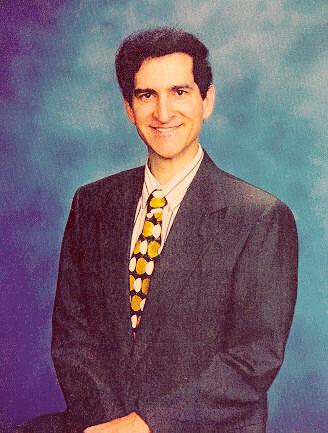
The more difficult problem was controlling AF. I had always been very athletic and started for a large high school's varsity basketball team (see photo). I continued to play strenuous sports into my early thirties. However, in my late twenties I noticed that during certain athletics my heart would start to beat irregularly -- and continue for up to almost a day. I also noticed that the same thing occurred sometimes late at night while sleeping on my back. From the late 80's to the mid 90's I had several tests done on my heart: 3 echocardiograms, 2 stress tests, several EKGs, and 1 Holter monitor. These tests show that I have a very normal, strong heart. Still, my heart can go into AF, and I have had 2 EKGs while in AF. These were taken when I saw doctors immediately after my heart started to beat irregularly. I am very conscious of my heart and have developed a sensitivity to it's rhythm; I sense my heart within my body, feel my pulse frequently, and listen with stethoscopes.
After much research and experimentation (again over 20 years), I never go into AF unless for known reasons, and then I am able to bring myself out of it within a few hours. I recently went over 6 years without a single episode. The solution is body mechanics, diet, and understanding. While the doctors I saw (including cardiologists) provided invaluable tests, the doctors' understanding of AF (including ability to correct and prevent) was minimal. However, there is good information on the Internet and in books. It is very important to control AF. If it becomes the dominate rhythm, serious problems can result. It is my opinion that the more one can stay out of AF, the more the heart can heal and strengthen itself (from going into AF).
 I found it very important to understand the workings of the heart. It is a complex, interrelated electromechanical organ. A signal starts from the sinus node, follows electrical pathways through the atria causing them to contract, and then the signal is relayed to the ventricles through the AV node. It is not hard to understand that disease or congenital defects can cause short circuits in the electrical pathways, resulting in irregular heartbeats. However, it is my opinion that great physical or emotional stress over several years can also cause short circuits to develop. This is why so many athletes -- especially basketball players -- develop AF. Obviously, this applies to me. It is also very important to realize that nutrition affects the functioning of the electrical system. Many different foods come into play, and of particular interest are those rich in sodium, potassium, calcium, magnesium, sugar, alcohol, and spices. Sodium, potassium, calcium, and magnesium directly affect the electrical capacity of the heart, and sugar (processed is worse than natural) is related to the energy available to the heart muscle. A thyroid condition can also trigger AF.
Whatever the reason, when a short exists in the heart, AF or a more serious problem may result. However, the problem may often be compensated for by physical and nutrition means. Think of the following analogy. Suppose you drove your car very hard and often and noticed that -- after awhile -- the engine started to ping frequently. A mechanic told you that the excessive stress on the engine caused minor problems with the timing, etc. However, you observed that if you ran the engine lightly (not accelerating harshly, etc.) and used premium gas, the pinging did not occur. So it is with the heart: if you do not over stress it and eat well, AF can often be eliminated. Obviously, your mechanic could fix the car, and your surgeon might be able to fix (cure) your heart. Great strides have been made in minimally-invasive, atrium-pathway ablation. However, I think it best to fix the problem naturally and non-surgically, all the while realizing that surgical methods are improving. Prescription drugs are also used to control AF. However, I believe these drugs to be harsh and very limited in their effectiveness, and you usually must take them long term.
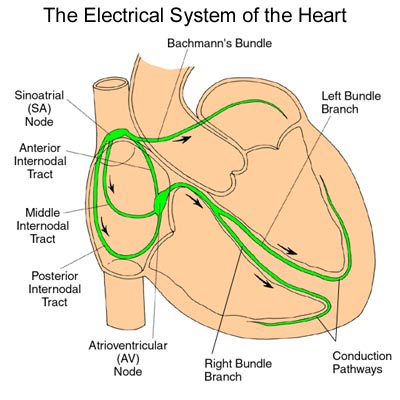
Diagram taken from http://www.methodisthealth.com/health/heart/electric.htm
First consider physical and emotional stress and body mechanics. I learned that only the most strenuous exercise -- usually when I was out of shape -- caused AF. Therefore I no longer play strenuous sports, period. All that is required for health is mild exercise, 3 times a week bringing the heart to the lower-end of the target rate for 1/2 to 1 hour. If my heart beats too fast and I notice palpitations, I immediately slow down. However, a very slowly beating heat is more likely to have stray beats, and therefore if I am sitting and notice palpitations, I stand. In contrast, though, if I am laying on my back and notice palpitations, I roll to my right side, because standing could trigger AF. Similarly, I sleep as much as possible on my right side, because my heart is most stable this way. While I believe very strenuous exercise over long periods is detrimental and promotes the development of short circuits, strenuous exercise may actually encourage short-term stability. (This is why I do not go into AF during strenuous exercise if I am in shape.) Light exercise is good for the heart and aids stability. Emotions affect the heart. I keep from getting extremely upset emotionally about anything, and if I do, I try to keep it from affecting my body.
Now consider nutrition. I eat a diet with balanced, optimal amounts of sodium, potassium, calcium, and magnesium (too much can be as bad as too little). I also avoid excessive amounts of processed sugar and drink very little alcohol. Sugar stabilization, via fiber, protein, and fat is valuable. For example, if I eat a bagel with lots of cream cheese first, donuts go from being unsafe to safe. There are obviously so many foods and combinations that it would be hard to define an exact diet. For example while too much chocolate can cause palpitations, I have found that a few raw cacao nuts stimulate the heart and aid stability (due to the small amount of caffeine?). Also mozzarella seems to be the best form of cheese, but even within brands, some mozzarellas are better than others. A negative example is eating half-a-bag of potato chips: very bad. Also, while olive oil is good fat (similar to my other oils) it causes, for me, heart palpitations and instability. As far as supplements, B6 and garlic cause palpitations for me; however, melatonin is very helpful and stabilizing.
Over the years I have made lists of foods and food combinations that are either helpful or dangerous. If I had to pick only one food I could eat, it would be pizza. It seems that the combination of protein and calcium in the cheese (mozzarella), sodium in the dough and cheese, potassium in the tomato sauce and some toppings, and low added processed sugar all add up to an excellent food for heart stabilization. Cheese burritos, eggs, ham and cheese omelets, and macaroni and cheese are also generally good. You must experiment, however. The following is an example of a very valuable diet (I eat only 2 meals per day) and gives me a very stable heart, with only a few noticeable, isolated palpitations per day. However, while a good diet promotes stability, my heart is nevertheless usually more unstable immediately after eating (regardless of diet). When I eat well, do not exercise strenuously, am calm emotionally, and sleep on my right side, my chances of going into AF are very, very small. (I have never gone into AF under these circumstances, and again have a very stable heart.) Conversely, it usually takes more than one factor to send me into AF, but when I combine eating poorly, sleeping on my back all night, and exercising unwisely, my chances of going into AF are greatly increased.
| Breakfast, 11a |
Food |
Comments |
| |
Raisin Bran plus Shredded Wheat, milk, canola/vegetable oil |
Good Na, K balance. High fiber. Natural sugar (raisins). Oil for lipids. |
| |
2.25 oz Mozzarella Cheese |
Good Ca, protein content. |
| |
Multi-vitamin, L-lysine, Ca/Mg, E, selenium, C supplements, 250mg Niacin, fish oil |
General health. Ca, Mg balance. Niacin and oil for lipids. |
| Dinner, 6:30p |
Food |
Comments |
| |
6-7 oz orange |
K, fiber and natural sugar (orange). |
| |
2.25 oz Mozzarella Cheese |
Good Ca, protein content. |
| |
1 Bean and Cheese Burrito, 5 oz |
Na, K, Ca Balance. Protein. Fiber. |
| |
Multi-vitamin, L-lysine, Ca/Mg, Beta Carotene, K supplements, fish oil |
General health. Ca, Mg balance. Oil for lipids. |
I hope my experiences and opinions are helpful. The AF problem is obviously more complex than the lipid problem, but with study and practice, both -- for me -- have been largely solved. Again though, your problem may be worse or of a different nature and my success may not work for you. Consult the literature and your doctor. A good heart forum may be found at http://www.medhelp.org/perl6/cardio/wwwboard.html. A good AF forum may be found at http://www.afibbers.org/forum/list.php?f=2. Good AF sites may be found at http://www.affacts.org/ and http://www.a-fib.com/.
Please also visit my site,
Faith & Reason Ministries:
Reconciling Christianity with Accepted Science,
http://www.faithreason.org/